Safety Trends: What the Data Reveals about Cycling in Ann Arbor
.png)
written by Greg L. Hughes
May is Bike Month, and it's a good time to take stock of where Ann Arbor stands on cycling safety — and what that means for the future of the Treeline.
What the Data Shows
In 2024, the Ann Arbor Downtown Development Authority partnered with local startup Velo AI to do something that doesn't happen often: actually measure what it feels like to ride a bike through the city.[1] Over roughly 50 hours of data collection, volunteer cyclists equipped with AI-powered devices captured how close and how fast vehicles passed them on five routes that lacked protected bike lanes — including portions of Miller Avenue, Division Street, and Packard Street.
The results were striking. Routes with standard or buffered bike lanes — where cyclists are separated from traffic by paint or a narrow painted buffer — had a stressful pass probability above 54%, while curb-protected lanes, which use a physical barrier like a raised curb or bollards, brought that figure down to just 12.5%. On North Division Street, outside the boundary of the downtown protected bikeway network, every single overtake event was classified as stressful. The data confirmed what cyclists in Ann Arbor have long known: infrastructure design doesn't just shape convenience, it shapes safety.
One study participant described living with the assumption that an encounter with a speeding driver is only a matter of time. For parents, the stakes feel even higher. Participants reported that cyclist friends with young children often felt too scared to ride with their kids anywhere beyond the DDA's protected cycle tracks.
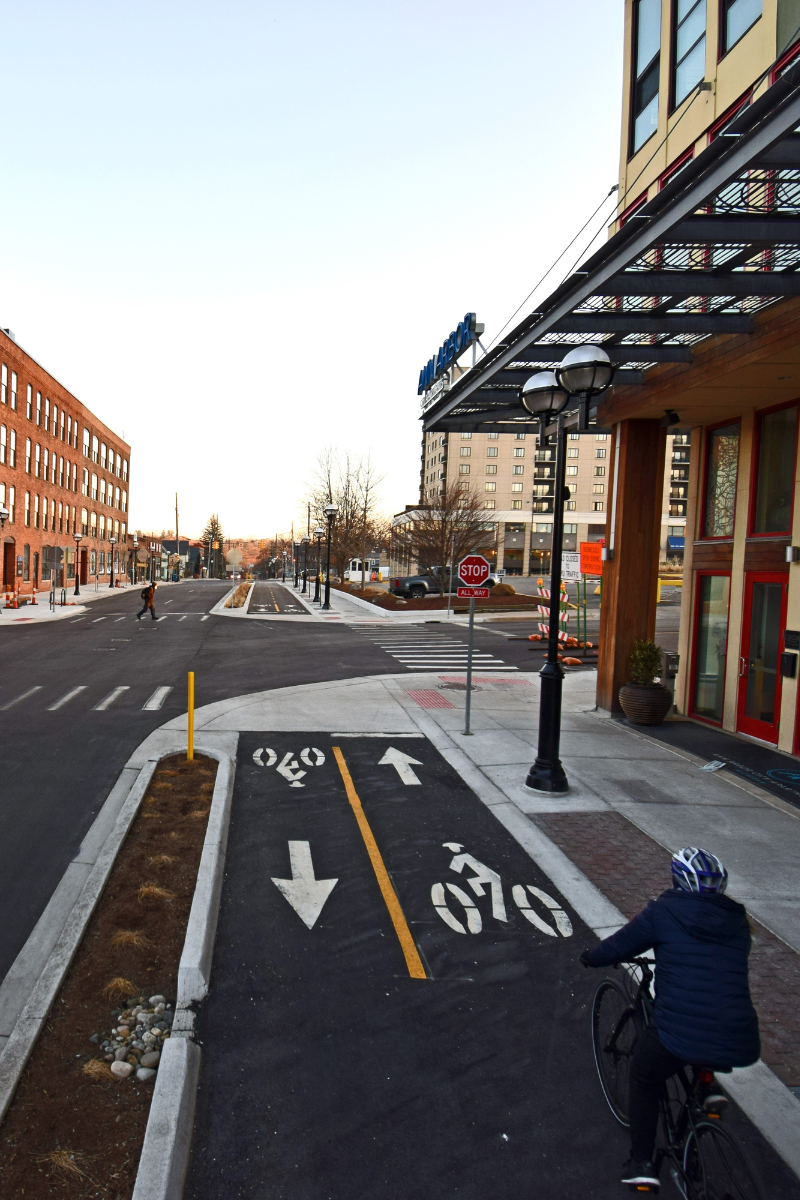
The Infrastructure Gap — and the Push to Close It
The Velo AI study reinforced what planners already suspected: the downtown bikeway network is working, but its reach is limited. Running concurrently, a separate downtown circulation study by the DDA and consulting group SmithGroup produced draft recommendations in late 2024 for extending protected bikeways along Catherine Street and Division Street. Miller Avenue was also on that list — and its two-way protected bikeway has since been completed, finishing this past winter. The recommendations also identified a connector through the city's 721 N. Main Street property toward Summit Street.[1]
That connection matters enormously to anyone following the Treeline — 721 N. Main runs through the same corridor at the heart of our Gateway Segment.
Last month, Ann Arbor City Council approved an expansion of the DDA's boundaries — the first since 1982 — adding 19 blocks to the north to strengthen connections between downtown, the Huron River, and the North Main and Broadway Bridge corridors.[2] Extension of the Division Street bikeway to the Broadway Bridge is now among the named priorities in the new development plan.

Why the Gateway Bridge Matters
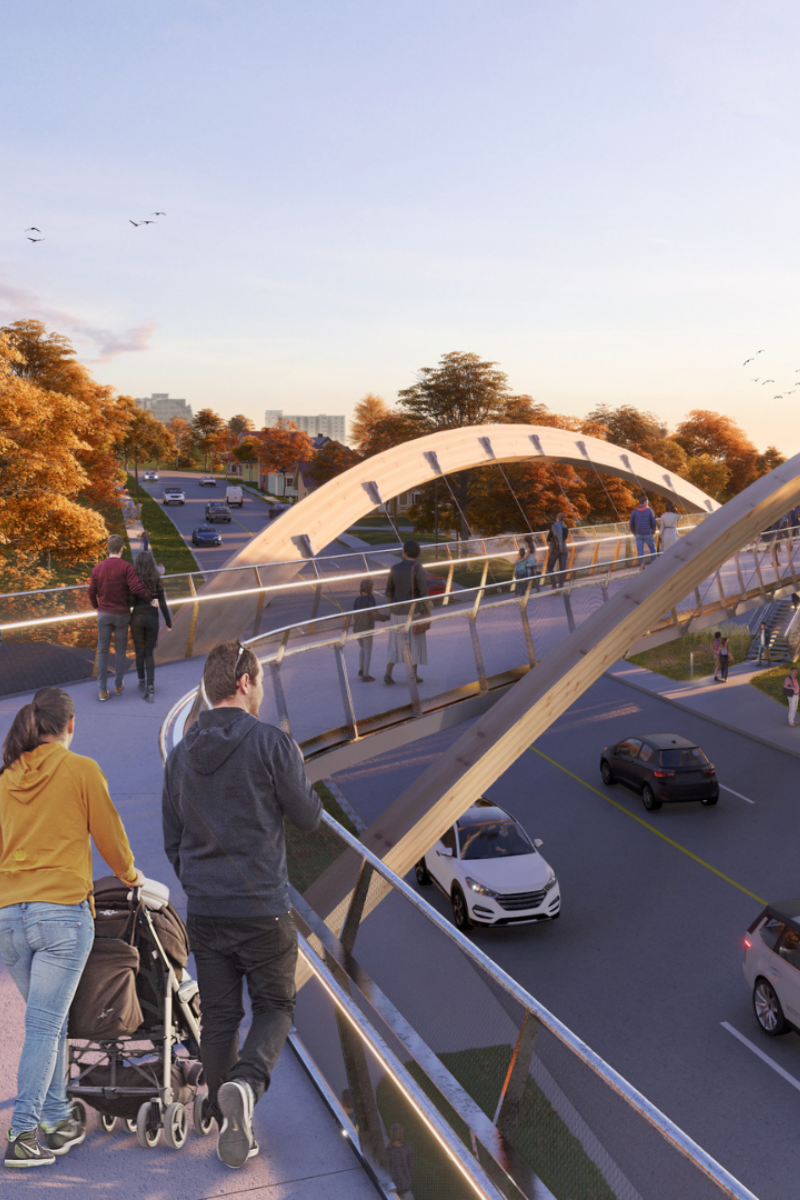
The Treeline's northern Gateway Segment is designed to thread through exactly this terrain, and its signature feature — a bridge crossing over North Main Street — is a direct response to one of the most persistent challenges in urban cycling: the gap between posted speed limits and actual operating speeds.
Near freeway interchanges and off-ramps, drivers carry momentum from higher-speed corridors. Even on streets with lower posted limits, the geometry and context of the road shape how fast most drivers actually travel. The North Main corridor off M-14 is precisely this kind of environment.
That's not incidental design. A grade-separated crossing removes the conflict entirely — cyclists (and pedestrians) wouldn't negotiate that intersection, they'd fly over it. It's a direct response to the safety evidence the DDA has now documented: physical separation, not paint or signs, is what meaningfully changes the risk equation.
The Legislative Picture
Michigan law requires drivers to give cyclists at least three feet of clearance when passing.f[3] The DDA study suggests that standard is frequently violated, and that enforcement alone isn't the answer. What the data argues for — and what the Treeline represents — is infrastructure that makes compliance irrelevant by design.
As Ann Arbor continues building out its protected bikeway network, the Treeline's Gateway Segment has an opportunity to become the northern anchor, linking the Huron River trail system to downtown, to the University of Michigan, and to the expanding grid the DDA is now formally empowered to develop.
Bike Month is a celebration. It's also a reminder that the work isn't done.
.png)
Sources
[1] Ann Arbor DDA / Velo AI Cycling Risk Study & Bikeway Extension Recommendations (MLive, December 2024). https://shorturl.at/Ag6UU
[2] "Ann Arbor City Council approves Downtown Development Authority's expansion to include critical northern corridors." City of Ann Arbor, April 21, 2026. https://www.a2gov.org/news/posts/ann-arbor-city-council-approves-downtown-development-authority-s-expansion-to-include-critical-northern-corridors/
[3] Michigan Vehicle Code — Bicycle Passing Distance (House Bills 4185 & 4265). https://www.cyclinglawyer.com/bike-laws
Blog Library
Learn more about the Treeline Project, initiatives, and our team members.
.png)
Ann Arbor's Transportation Future, One Year Later
.png)
Beyond Honey Bees: 10 Kinds of Bees You Might See Along the Treeline
%20.png)